Polynucleotide Hair Loss Treatment: Does It Really Work?
Written by Rahena, Level 7 Aesthetic Practitioner | Mesglo London
Published
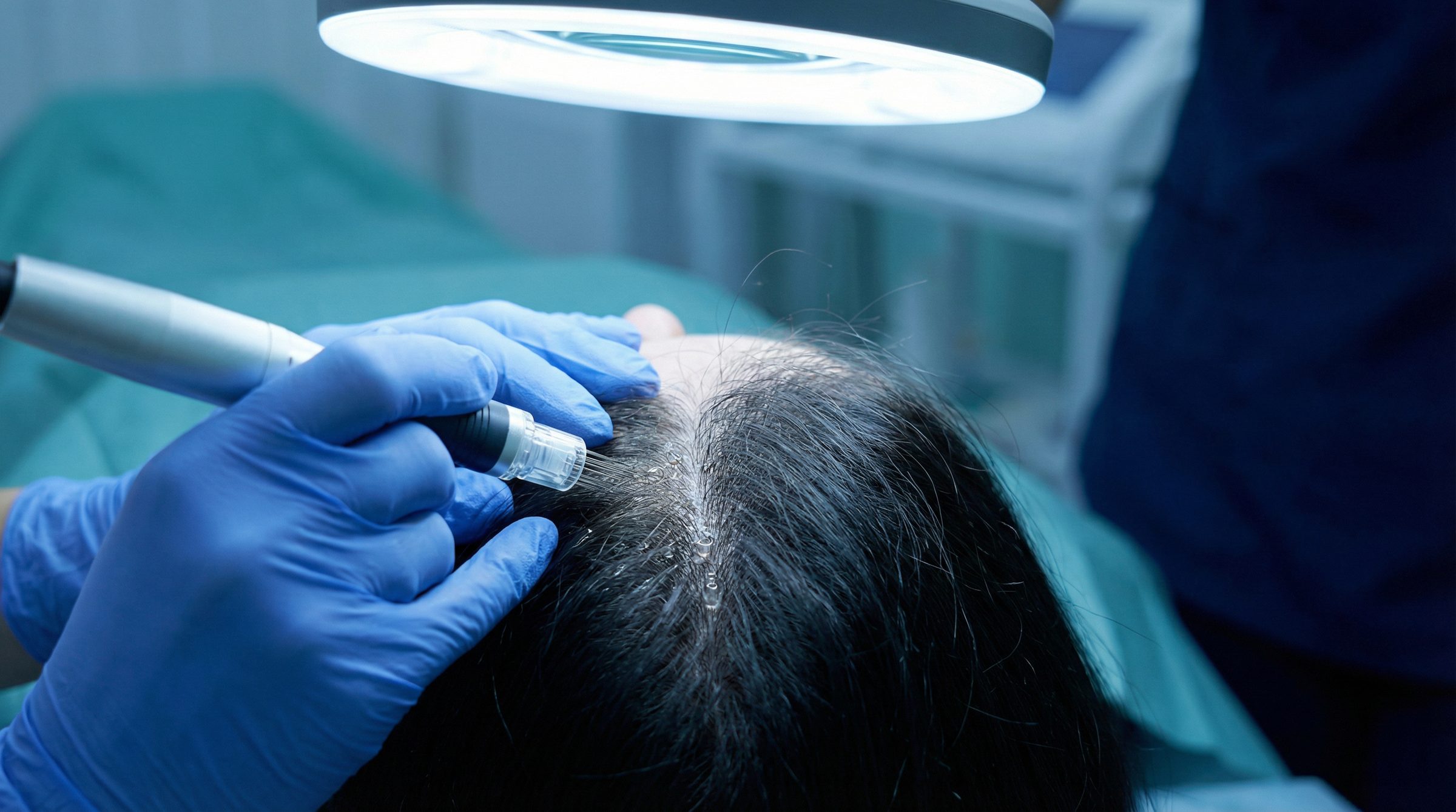
Hair loss affects millions of people in the UK, yet many remain unaware of the significant advances in regenerative medicine that have transformed the treatment landscape over the past decade. Polynucleotide therapy, long established in South Korea and Italy as a first-line treatment for androgenetic alopecia and diffuse hair thinning, has arrived in London with a compelling evidence base and results that are genuinely changing lives. At Mesglo London, we offer polynucleotide scalp treatment as part of a comprehensive regenerative hair restoration programme. This guide explains exactly how it works, what the clinical evidence shows, and what you can realistically expect.
What Are Polynucleotides and How Do They Treat Hair Loss?
Polynucleotides are purified DNA fragments derived from salmon sperm cells. When injected into the scalp, they activate A2A adenosine receptors in the hair follicle microenvironment. This activation triggers a cascade of regenerative responses: increased fibroblast activity, improved blood supply to the dermal papilla (the structure that feeds the hair follicle), reduced inflammation, and stimulation of the anagen (growth) phase of the hair cycle.
Unlike minoxidil or finasteride, which work by altering hormone pathways or increasing blood flow pharmacologically, polynucleotides work at the cellular level to address the underlying biology of follicle miniaturisation. They do not simply slow hair loss; they actively support the conditions necessary for follicle regeneration and new hair growth.
The treatment is administered as a series of micro-injections across the scalp, typically targeting the areas of greatest thinning. A topical anaesthetic is applied beforehand to ensure comfort. Each session takes approximately 30 to 45 minutes.
What Does the Clinical Evidence Show?
The evidence base for polynucleotide scalp treatment has grown substantially in recent years. A 2022 study published in the Journal of Cosmetic Dermatology demonstrated that patients receiving PDRN scalp injections showed a statistically significant increase in hair shaft diameter and hair density after six sessions, compared to a control group. A separate Italian study found that polynucleotide therapy was comparable to PRP (platelet-rich plasma) in terms of hair density improvement, with a superior safety profile and lower incidence of post-treatment discomfort.
At Mesglo London, we use clinically validated polynucleotide formulations and follow evidence-based protocols to ensure our patients achieve the best possible outcomes.
| Treatment | Mechanism | Sessions Required | Evidence Level | Downtime |
|---|---|---|---|---|
| Polynucleotides (PDRN) | Cellular regeneration, A2A receptor activation | 3–6 sessions | Strong (multiple RCTs) | Minimal |
| PRP (Platelet-Rich Plasma) | Growth factor delivery | 3–6 sessions | Moderate | Minimal |
| Exosome Scalp Treatment | Cellular signalling, stem cell activation | 2–4 sessions | Emerging | Minimal |
| Minoxidil (topical) | Vasodilation, hair cycle prolongation | Ongoing daily use | Strong | None |
| Finasteride (oral) | DHT inhibition | Ongoing daily use | Strong (men only) | None |
Who Is a Good Candidate for Polynucleotide Hair Treatment?
Polynucleotide scalp treatment is suitable for both men and women experiencing hair thinning or early to moderate hair loss. It is particularly effective for patients with androgenetic alopecia (the most common form of hair loss, caused by genetic sensitivity to dihydrotestosterone), diffuse thinning across the scalp, and post-partum hair loss in women.
The treatment is less effective for patients with advanced alopecia areata or scarring alopecia, where the follicles may be permanently damaged. A thorough scalp assessment at Mesglo London will determine whether polynucleotide therapy is appropriate for your specific pattern and degree of hair loss.
- Androgenetic alopecia (male and female pattern baldness)
- Diffuse hair thinning across the scalp
- Post-partum hair loss
- Stress-related telogen effluvium
- Early-stage alopecia areata
- Hair thinning associated with nutritional deficiencies
What Results Can You Expect and When?
Polynucleotide hair treatment produces gradual, progressive results. Most patients begin to notice reduced hair shedding after the second or third session, with visible improvements in hair density and thickness becoming apparent between three and six months after beginning treatment. The full benefit of a complete course is typically seen at six to nine months.
It is important to have realistic expectations: polynucleotide therapy will not regrow hair in areas where follicles have been permanently lost. However, for patients with active follicles that have miniaturised or entered a prolonged resting phase, the results can be genuinely transformative.
Combining Polynucleotides with Exosome Scalp Treatment
For patients seeking the most comprehensive regenerative approach to hair loss, we recommend combining polynucleotide scalp injections with exosome therapy. Exosomes, nano-sized vesicles carrying growth factors and genetic signalling molecules, work synergistically with polynucleotides to accelerate follicle regeneration and improve scalp health. The combination protocol typically involves alternating sessions of each treatment over a six-month period, followed by maintenance sessions as required.
Conclusion
Polynucleotide hair loss treatment represents one of the most significant advances in non-surgical hair restoration available in London today. With a strong clinical evidence base, minimal downtime, and results that address the underlying biology of hair loss rather than simply masking it, PDRN therapy is an increasingly important tool in the regenerative hair restoration toolkit. At Mesglo London, we combine polynucleotide scalp treatment with exosome therapy and personalised lifestyle guidance to deliver the most comprehensive non-surgical hair restoration programme available in Marylebone. Book a consultation to receive a thorough scalp assessment and personalised treatment plan.
Frequently Asked Questions
- How many polynucleotide hair treatment sessions do I need?
- Most patients require three to six sessions, spaced two to four weeks apart, to achieve optimal results. A maintenance session every six to twelve months is then recommended to sustain the improvement.
- Is polynucleotide hair treatment painful?
- A topical anaesthetic cream is applied to the scalp before treatment, which significantly reduces discomfort. Most patients describe the sensation as mild pressure or a slight stinging. The procedure takes 30 to 45 minutes and patients can return to normal activities the same day.
- How does polynucleotide hair treatment compare to PRP?
- Both treatments stimulate hair follicle regeneration, but through different mechanisms. PRP uses growth factors from your own blood, while polynucleotides work by activating cellular receptors to trigger regeneration. Clinical evidence suggests comparable efficacy, with polynucleotides offering a more consistent treatment experience and a lower risk of post-treatment discomfort.
- Can women have polynucleotide hair treatment?
- Yes: polynucleotide scalp treatment is suitable for both men and women. It is particularly effective for female pattern hair loss and post-partum thinning, which are among the most common presentations we see at Mesglo London.
- What is the cost of polynucleotide hair treatment in London?
- Polynucleotide hair treatment at Mesglo London starts from £350 per session. A course of three to six sessions is usually recommended, and package pricing for a course is confirmed at your consultation.
Related Treatments at Mesglo London
Related Articles You May Find Useful
- Hair Restoration Without Surgery: Regenerative Treatments That Actually Work (Hair Treatments)
- Female Hair Thinning Treatments in London: A Clinical Guide (Hair Treatments)
- Polynucleotides vs PRP for Hair Loss: Which Is Better in 2025? (Hair Treatments)
- Skinfill Bacio vs Lip Filler: Which Lip Treatment Is Right for You? (Lip Treatments)
Book a consultation at Mesglo London to discuss this treatment.
View our before and after results to see real patient outcomes.
Browse all articles on the Mesglo London blog for more expert insights.