
Exosome Therapy for Scar Healing in London: The Science Behind Cellular Regeneration
Written by Rahena, Level 7 Diploma, ACE certified · 13 February 2026 · 10 min read
Key Takeaways
The pursuit of flawless skin is a timeless endeavour, yet the shadows of scars (be they from acne, surgery, or injury) can feel like permanent marks against that goal. For years, treatments have offered incremental improvements, but true, deep-level regeneration has remained elusive. Now, a paradigm shift is occurring in the world of regenerative aesthetics, driven by a microscopic powerhouse: the exosome. At Mesglo London, our Marylebone centre is at the forefront of this revolution, offering advanced Exosome Therapy to fundamentally rewrite the story of your skin. Exosomes are not cells, but rather potent, nanoscopic vesicles that act as messengers, carrying a cargo of proteins, growth factors, and genetic information between cells. They are the driving force behind cellular repair and rejuvenation. This article delves into the compelling science behind how exosome therapy promotes profound scar healing and skin regeneration, exploring its mechanisms, the clinical evidence supporting its use, and how it stands apart from other treatments. We will uncover how this cutting-edge therapy is not just about fading scars, but about instructing your skin to rebuild itself, stronger and healthier than before.
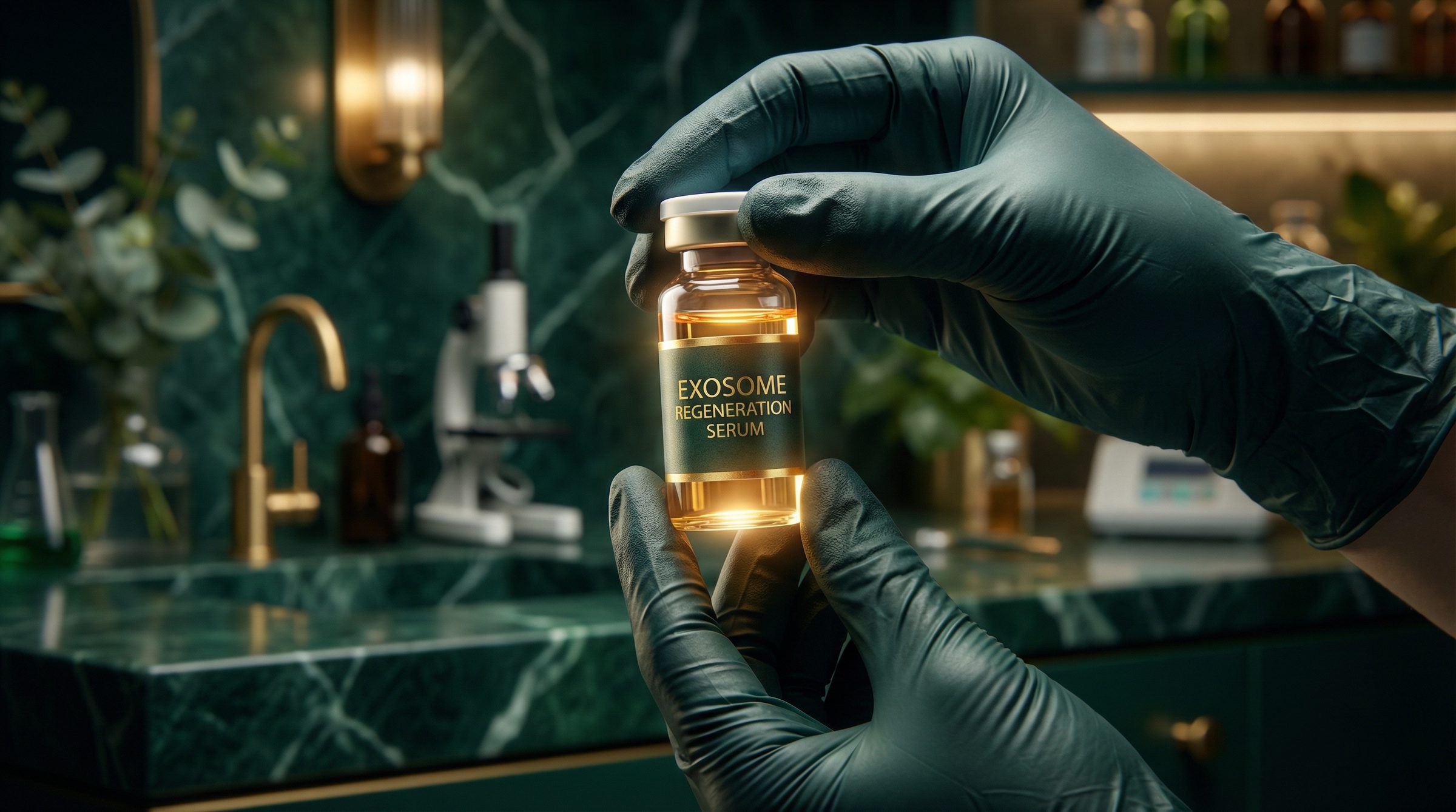
- Exosome therapy is a cutting-edge, acellular treatment that uses nanoscopic vesicles from stem cells to direct skin repair and regeneration
- It works by delivering a complex cargo of growth factors, proteins, and genetic information to target cells, modulating inflammation, promoting blood vessel formation, and normalising collagen production
- Clinical evidence shows exosome therapy is highly effective for treating various scar types, including acne, surgical, and traumatic scars, especially when combined with treatments like microneedling
- Compared to PRP, exosome therapy offers a more potent, consistent, and complex regenerative signal without the need for a blood draw
- Unlike Polynucleotides which provide building blocks, exosomes provide comprehensive instructions, acting as a master regulator of the healing process
Understanding Scar Formation: A Cellular Perspective
Scars are the visible reminders of the skin’s healing journey, a complex biological process that unfolds in four distinct phases: haemostasis, inflammation, proliferation, and remodelling. When the skin is injured, the body’s first response is to stop the bleeding (haemostasis) and then initiate an inflammatory response to clear debris and prevent infection. This is followed by the proliferative phase, where new tissue, blood vessels, and collagen are rapidly formed to close the wound. The final stage, remodelling, can last for months or even years, as the newly laid collagen is reorganised and strengthened.
However, when this intricate process is disrupted, a scar is born. If the inflammatory response is too prolonged or the production of collagen, the skin’s primary structural protein, is imbalanced, the resulting tissue can be visibly different from the surrounding skin. Atrophic scars, such as the pitted depressions left by acne, occur when not enough collagen is produced. Conversely, when the body produces an excess of collagen, the result is a raised, often discoloured hypertrophic scar or, in more severe cases, a keloid that grows beyond the original wound boundaries.
The challenge in treating these scars lies in correcting this deep-seated architectural flaw in the skin’s extracellular matrix (ECM). Traditional treatments often only address the surface, but to truly resolve a scar, we must communicate with the cells responsible for its creation and guide them toward a more regenerative, less reactive, state.
Exosome Therapy Explained: Beyond Stem Cells
For years, stem cell therapy was hailed as the pinnacle of regenerative medicine, but the focus is now shifting to the powerful messengers these cells produce: exosomes. Exosome therapy represents a more refined, targeted, and safer approach to skin regeneration. Exosomes are extracellular vesicles, tiny lipid-bound sacs measuring just 30 to 150 nanometres in diameter, that are secreted by nearly all cell types, including the potent Mesenchymal Stem Cells (MSCs) that are the gold standard in regenerative medicine.
Think of them not as the construction workers (the cells), but as the architects’ blueprints and the project managers’ instructions, all delivered in one highly efficient package. These vesicles are loaded with a rich and complex cargo of bioactive molecules, including over 1,000 types of proteins, growth factors, amino acids, and genetic material like messenger RNA (mRNA) and microRNA (miRNA).
When introduced into the skin, they fuse with target cells, such as fibroblasts and keratinocytes, and deliver these instructions directly, kickstarting a powerful cascade of regenerative activity without introducing foreign cells into the body. This acellular nature makes exosome therapy an exceptionally safe treatment, minimising the risks of immune rejection or other complications associated with live cell therapies.
Expert Insight: At Mesglo London, we harness the power of purified, high-concentration exosomes to ensure a potent regenerative signal is delivered directly to the target area. By using a refined and concentrated product, we optimise the skin’s natural repair processes far beyond what the body could achieve on its own.
The Mechanism of Action: How Do Exosomes Heal Scars?
The true power of exosome therapy for scars lies in its multifaceted mechanism of action. Unlike single-molecule treatments, exosomes orchestrate a symphony of cellular responses to guide the tissue away from scarring and towards regeneration. Their primary role is to modulate cellular communication, delivering a potent cocktail of growth factors and cytokines that recalibrate the healing environment.
This includes down-regulating pro-inflammatory signals that can lead to excessive scarring while promoting a pro-healing, anti-inflammatory state. Furthermore, exosomes are instrumental in promoting angiogenesis, the formation of new blood vessels, which is critical for supplying oxygen and nutrients to the healing tissue, ensuring a healthier, more robust repair process.
At the heart of scar formation is the behaviour of fibroblasts, the cells responsible for producing collagen. Exosomes regulate fibroblast activity, signalling them to produce a balanced amount of organised, healthy Type I and Type III collagen, rather than the dense, disorganised collagen that forms scar tissue. They also stimulate the remodelling of the extracellular matrix (ECM), encouraging the breakdown of old, fibrotic scar tissue and its replacement with a more functional, aesthetically pleasing skin structure.
Clinical Backing: What Does the Research Say About Exosomes and Scars?
The scientific community has taken a keen interest in exosome therapy, and a growing body of evidence supports its efficacy in dermatology. While much of the initial research was preclinical, involving in-vitro and animal models, these studies laid a crucial foundation, demonstrating that exosomes could accelerate wound closure, reduce inflammation, and promote higher-quality tissue formation.
More recently, clinical studies in humans have begun to validate these promising results. A key area of focus has been the treatment of atrophic acne scars, a notoriously difficult condition to manage. Research has shown that when exosome therapy is combined with collagen-induction therapies like microneedling, the results are significantly enhanced.
One split-face clinical trial found that the side treated with both microneedling and exosomes showed a greater reduction in scar depth, less post-procedure redness, and faster recovery times compared to microneedling alone. This synergistic effect occurs because microneedling creates micro-channels that allow for deeper penetration of the exosomes, while the exosomes, in turn, amplify the healing response initiated by the microneedling. The evidence also extends to surgical and traumatic scars, where the application of exosomes post-procedure has been shown to minimise the formation of hypertrophic scars and improve the final cosmetic appearance.
How Does Exosome Therapy Compare?
In the landscape of regenerative aesthetics, several treatments aim to stimulate the body’s own healing mechanisms. However, exosome therapy distinguishes itself through its unique mechanism and potency. Understanding these differences is key to appreciating why it is often considered the next generation of skin repair. While treatments like PRP and Polynucleotides are valuable tools, exosomes operate on a more comprehensive and sophisticated level.
| Feature | Exosome Therapy | PRP (Platelet-Rich Plasma) | Polynucleotides (PNs) | Microneedling |
|---|---|---|---|---|
| Primary Mechanism | Cellular communication and direction of regeneration | Growth factor release to stimulate healing | Biostimulation and providing DNA building blocks | Controlled micro-injury to induce collagen production |
| Source | Mesenchymal Stem Cells (purified) | Patient’s own blood | Salmon DNA (purified) | N/A (procedure-based) |
| Requires Blood Draw? | No | Yes | No | No |
| Key Bio-active Components | Growth factors, cytokines, mRNA, miRNA | Platelet-derived growth factors | DNA fragments, nucleotides | N/A |
| Primary Benefit | Comprehensive regeneration and scar remodelling | General skin rejuvenation and healing boost | Improved skin health, hydration, and elasticity | Improved texture, collagen induction, and product penetration |
| Best For | Difficult scars, advanced anti-ageing, comprehensive regeneration | Mild texture issues, overall skin revitalisation | Dehydrated skin, fine lines, improving skin quality | Atrophic scars, uneven texture, enhancing product efficacy |
| Downtime | Minimal, reduces downtime of other procedures | 1 to 3 days of redness and swelling | Minimal, possible minor bruising | 1 to 3 days of redness |
Exosome Therapy vs. Platelet-Rich Plasma (PRP)
PRP therapy involves drawing a patient’s own blood and centrifuging it to concentrate the platelets, which are then reinjected into the skin. These platelets release growth factors that stimulate healing. While effective, PRP has limitations. The quality and concentration of growth factors can vary significantly depending on the individual’s age, health, and blood quality. Furthermore, PRP primarily provides the initial signal for repair.
Exosome therapy, by contrast, uses exosomes derived from MSCs, which are far more potent and consistent. These exosomes contain a much wider and more complex array of growth factors, cytokines, and genetic material. They do not just initiate repair; they actively manage and direct the entire regenerative process. Being acellular, exosome therapy also eliminates the need for a blood draw, making it a more comfortable and convenient option for many patients.
Exosome Therapy vs. Polynucleotides (PNs)
Polynucleotide treatments are another exciting advancement in regenerative medicine. They use long chains of DNA fragments to signal the skin to repair itself, acting as a biostimulator that improves skin health from within. PNs provide the building blocks and the signal for cells to produce collagen and elastin. However, their action is more focused on providing the raw materials and a general wake-up call to the cells.
Exosomes, on the other hand, deliver a more specific and comprehensive set of instructions. They are less about providing the building blocks and more about being the project manager, directing the fibroblasts and other cells on precisely how to use those building blocks to create a healthy, well-structured skin matrix. While both are excellent for skin regeneration, exosomes offer a more sophisticated and commanding influence over the cellular environment, making them particularly powerful for complex issues like scarring.
Exosome Therapy vs. Traditional Scar Treatments
When compared to traditional scar treatments such as silicone sheets, steroid injections, or older laser technologies, the difference is even more stark. These methods are largely corrective or suppressive. For instance, steroid injections reduce inflammation and collagen production in hypertrophic scars, while lasers resurface the top layer of skin.
Exosome therapy is fundamentally different. It is not just correcting the problem; it is regenerating the solution. It works at a cellular level to encourage the body to replace damaged, fibrotic tissue with healthy, functional tissue, addressing the root cause of the scar rather than just its surface appearance. This regenerative approach leads to more natural, long-lasting, and comprehensive results.
Frequently Asked Questions
What is the difference between stem cell therapy and exosome therapy?
Stem cell therapy involves introducing live stem cells into the body to repair damaged tissue. While powerful, it carries risks such as immune rejection and unwanted cell differentiation. Exosome therapy is a more refined and safer evolution of this concept. Instead of using the whole cell, it uses only the exosomes, the potent messaging vesicles, that the stem cells produce. This provides all the regenerative instructions without the risks associated with cellular therapy, making it an acellular, non-living treatment.
How many exosome treatments are needed to see results for scars?
The number of treatments required depends on the type, age, and severity of the scar, as well as the individual’s skin condition. While some patients may notice improvements after a single session, a course of 3 to 5 treatments, spaced 4 to 6 weeks apart, is typically recommended for optimal and lasting results. During your consultation at our Marylebone clinic, we will create a personalised treatment plan for you.
Is exosome therapy painful?
Exosome therapy itself is not painful. The exosomes are typically applied topically to the skin and delivered into the deeper layers via another procedure, most commonly microneedling or fractional laser. A topical numbing cream is applied before these procedures to ensure patient comfort. The application of exosomes can actually help to reduce the discomfort and inflammation associated with the delivery method, leading to a more comfortable experience and faster recovery.
Can exosome therapy be combined with other treatments like Mesotherapy or Microneedling?
Absolutely. Exosome therapy is an ideal combination treatment. It acts as a powerful booster to other aesthetic procedures. When combined with microneedling, it enhances collagen induction and accelerates healing. It can also be paired with mesotherapy to deliver a potent cocktail of regenerative signals alongside nourishing vitamins and minerals. Combining treatments allows us to create a highly customised and synergistic approach to achieve the best possible results.
Who is an ideal candidate for exosome therapy for scars at Mesglo London?
An ideal candidate is anyone seeking a significant improvement in the appearance of scars (including atrophic acne scars, surgical scars, or scars from past injuries) who wants to pursue a regenerative, science-backed approach. It is suitable for all skin types and is an excellent option for individuals who want to avoid more invasive procedures or who have found that other treatments have provided limited results. A consultation at our London clinic is the best way to determine if exosome therapy is the right choice for your specific goals.
Exosome therapy is not merely another option in the fight against scars; it represents a fundamental leap forward in our understanding of skin science. By moving beyond simple surface correction and embracing true cellular regeneration, we can now address the very foundation of scar tissue. The science is clear: exosomes act as master conductors of the healing process, orchestrating a complex series of events that reduce inflammation, normalise collagen, and rebuild the skin’s matrix from the inside out. This versatile, potent, and safe therapy offers new hope for those with persistent acne scars, surgical marks, and other textural imperfections, delivering results that are both profound and lasting. If you are ready to explore how the regenerative power of exosome therapy can transform your skin and finally put the story of your scars behind you, we invite you to our clinic in Marylebone, London. Book a consultation with our specialists today to receive a personalised treatment programme and discover the future of skin healing.
Related Treatments at Mesglo London
Exosome Face TreatmentPolynucleotide Face TreatmentMicroneedlingMesotherapyShare this articleFurther Reading
Acne Scar Treatment in London: The Complete Guide to Regenerative Solutions
14 min read
Hypertrophic Scar Treatment: Regenerative Solutions in London
13 min read
Microneedling for Scars: The Complete Guide to Collagen Induction Therapy in London
14 min read
Skinfill Bacio vs Lip Filler: Which Lip Treatment Is Right for You?
9 min read
Exosome Therapy in London: The Complete Guide to Regenerative Aesthetics
12 min readReady to Transform Your Skin?
Book a consultation at our Marylebone clinic.
Book ConsultationBrowse Categories
Regenerative TreatmentsSkin TreatmentsAnti-Wrinkle TreatmentsTreatment GuidesScar TreatmentsDermal FillersHair Treatments“5 star service, results and aftercare. I appreciate the holistic approach - it provides natural-looking, longer-lasting results because it targets the root causes.”Read all reviews

Talk it through with Rahena
A consultation at 4 Baker Street comes first in every case. Rahena assesses your skin or hair, explains what would and would not help, and there is no obligation to go ahead.